
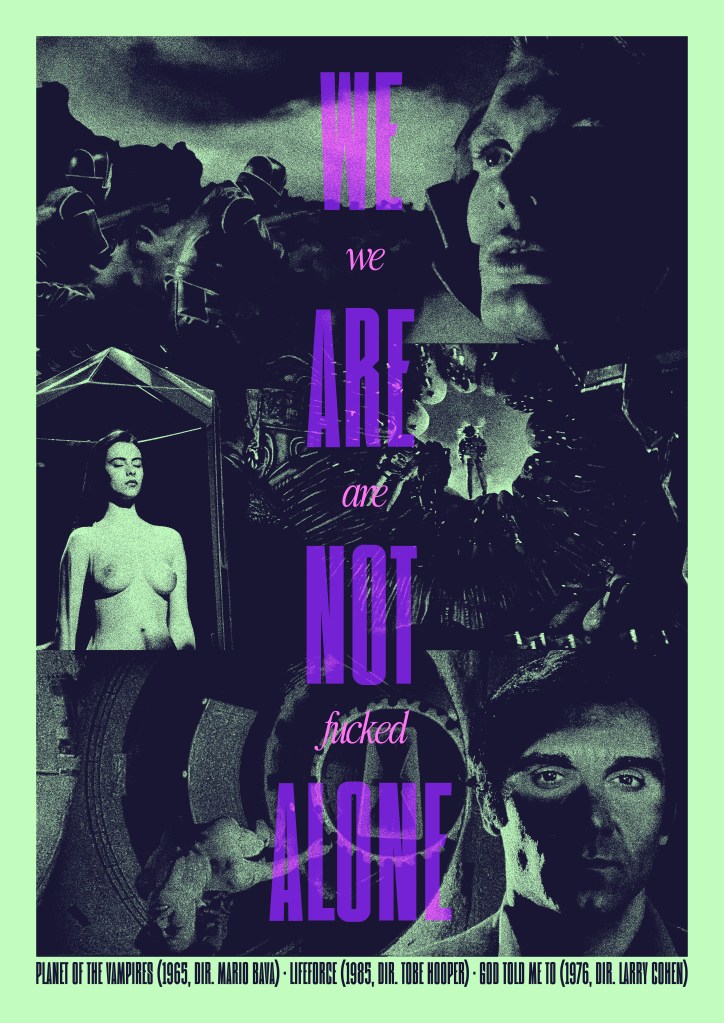
Created for HalloRe’ewind 2025
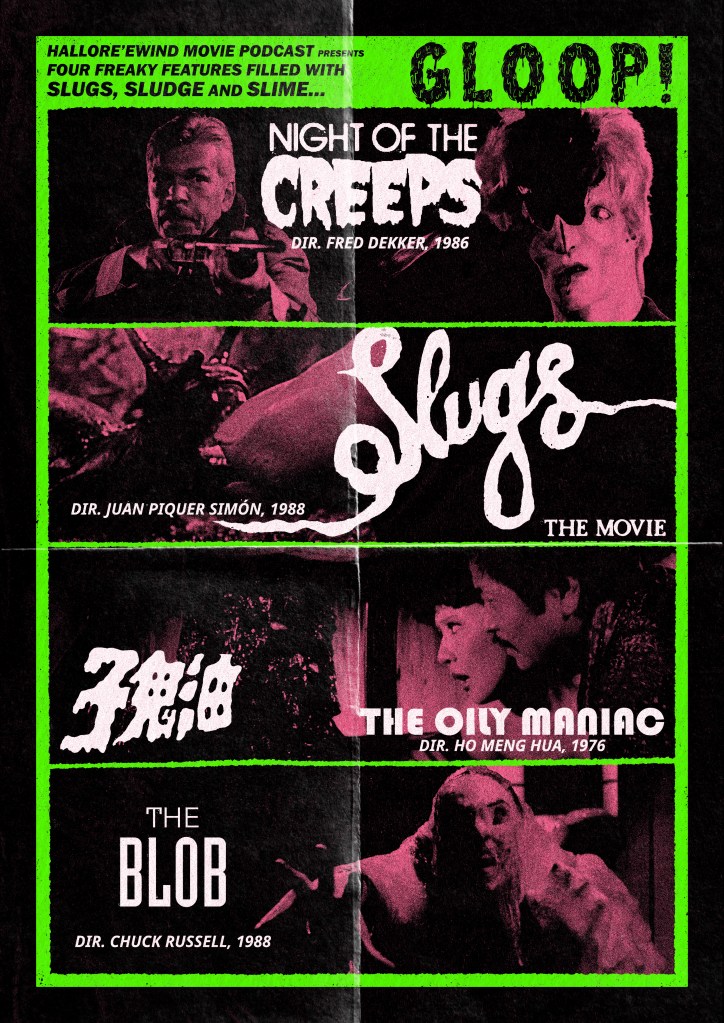
Created for HalloRe’ewind 2023
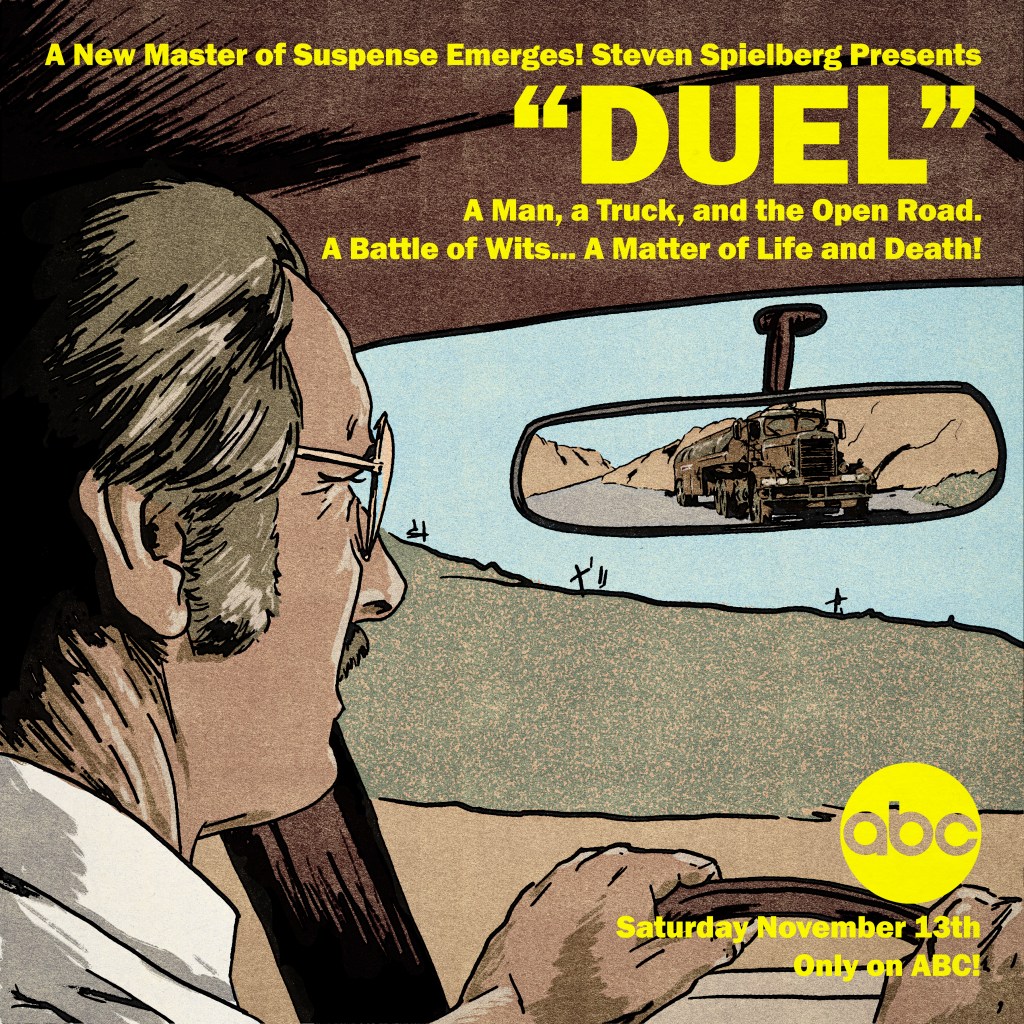
Created for our Rewind episode on Steven Spielberg’s debut feature (originally an ABC Movie of the Week, of course!)
This one started life as an incredibly janky composite of screenshots in Photoshop, just to see how best to organise the elements into the square frame. I pulled a stack of images and pushed a few around, eventually landing on a layout that had a dominant, but indirect, image of lead actor Dennis Weaver, with the truck looming in his rearview mirror:
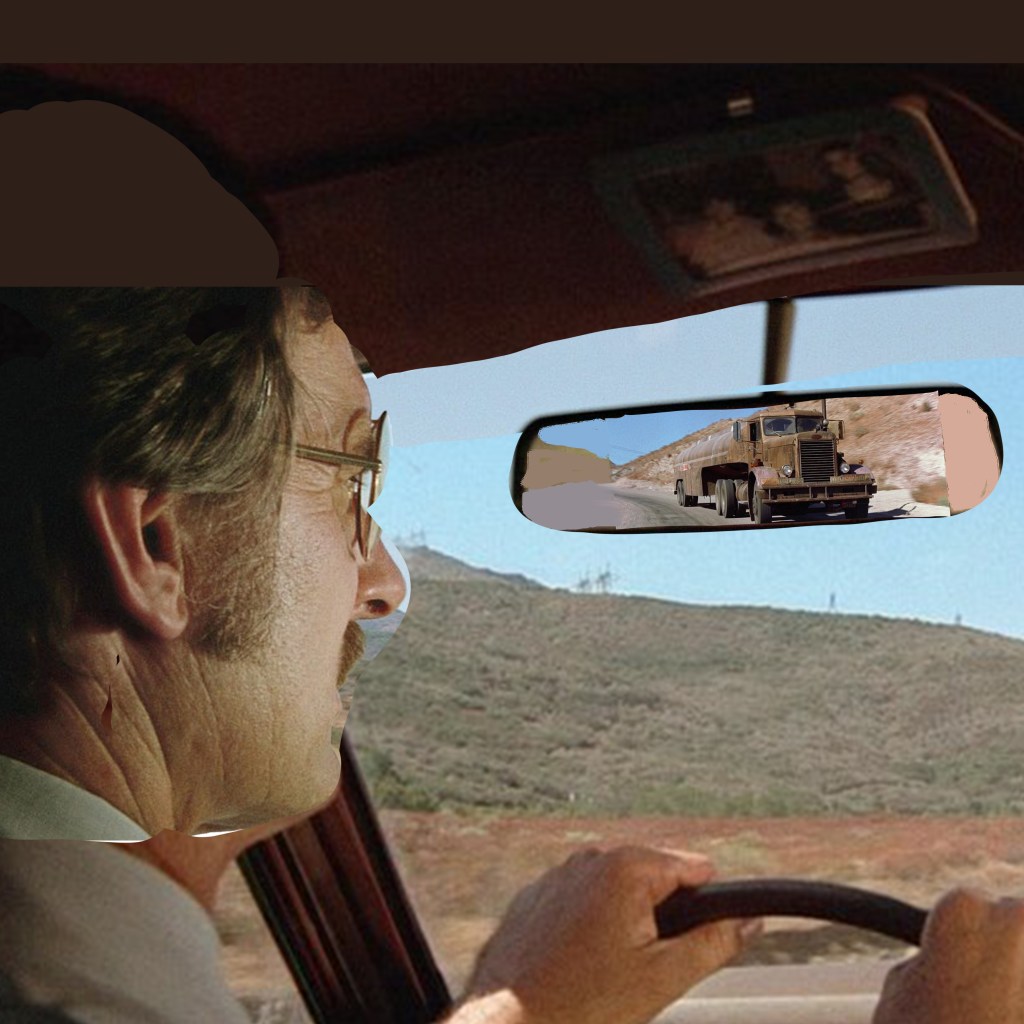
As a cover image that would be primarily used on podcast platforms, it would need to be a square format. Given that most of my design work recently is intended for Rewind episodes, that has meant that I’ve had to become comfortable with an image shape that I don’t find particularly natural or accomodating. Although, in this instance, it was useful on two counts – first, for a sense of claustrophobia that suits the film’s juxtaposition of wide-open vistas and sweaty, intimate in-car panic. And second, to mimic the boxy format that the original airing would have had, before the theatrical re-edit that opened up to widescreen.
Downsides – of course, a driver would not have a rearview mirror jammed right in front of their eyeline. And, without being able to open up the format to something wider, that meant that the truck – the main selling point of the film – would appear pretty small overall. So, I wanted to mitigate by ensuring that David Mann’s eyeline leads the viewer right to the truck. That it would sit in and break up a patch of pleasant blue sky and provide a messy, eye-catching feature among an otherwise quite simple layout.
That influenced how I drew the final piece, too. I still did not know how I would render this. Realistic? Illustrative? Painterly? A big factor, perhaps the main factor, was time. And skill. I would have trusted myself to render something more representative of real life if I had time to transfer the image to paper and render in charcoals. But I didn’t see that I would be able to do it justice in that format – it didn’t really suit the image, which I use more often for more traditional portature. I also just do not have the skill to render realistically in digital illustration. I have only a stylus that interacts with my touchscreen laptop, which is not a professional grade drawing tablet. And I don’t find digital illustration intuitive at all. I would love to be able to layer delicate brush work to build up the atmosphere, but it’s not something I know how to do.
So that left me with something more like a vintage comic book style – like Creepshow. I first laid down the ink work – using a variable width ink brush from True Grit Texture Supply Co. I laid a flat white layer down, and varied the opacity so I could see different levels of detail of the photomontage beneath for a loose trace. I intentionally used a wider brush on the car, the environment, and David – around 16-18 pixels I think – than I used on the truck, more like 8-10 pixels. The extra detail was to ensure that, if the viewer really got into looking closely, there was enough of the unique character of the truck to be interesting.
Then, again, to save time, I blocked in the colours extremely flat. I limited to around 6 colours in total, I think – all were droppered from the reference picture itself and then tweaked a little, to ensure that despite the cartoony render, it would be grounded in realistic colour tones. One flat tone for the sandy landscape, one for David’s main skin tone, one for the grass, a dark maroon for the car interior, and a specific tone for the truck. I think also the dashboard is a slightly different beige. Can’t remember. You can see below, without the ink work:
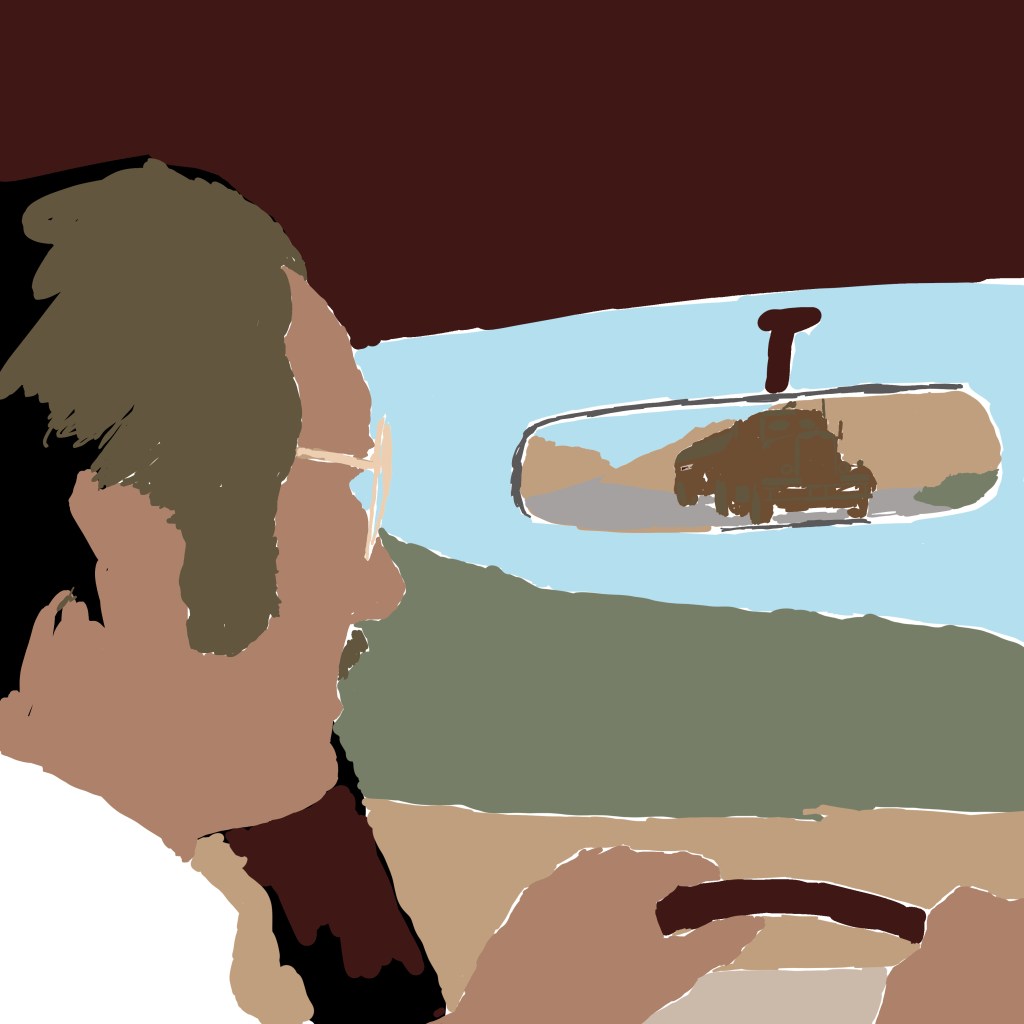
Then, it was time to add high and lowlights. I used a brush called Dry Brush Inker, that allowed for a bit of a break from anything too cheap-looking – I wanted a semblance of tactility. I also used the sandy colour as a texture to lay over the grass, to stop that looking too lush and keep the desert look intact. This was my second attempt – initially, I used a grain shader to try to build up detail and visual interest across all the areas. But this looked too modern, too much like a 2010s comic book – it couldn’t concievably pass as a vintage illustration. Using these modern techniques to ape obsolete techniques is always a fine line to walk. Obvious pastiche looks cheap. It was also important to NOT introduce any new colours at this point – all digital paint added to the image is drawn from that original palette.
Once the colours and the inks looked about right, I exported the inks alone as a PNG, and used a Photoshop process from Spoon Graphics called Bad Print Effects to add a number of filters and degradations that would mitigate the clean, boring flat vector style that it had. I did not process the colour elements – I find it a bit too harsh on those, so processed the colour paint layers separately in Camera Raw Filter and just added grain and texture, also using a vintage paper texture as an added layer to give some variance. But, it really helps to give the solid ink lines some imperfections and a hint of translucence – I used the same process on my Coffy poster.
The Bad Print process also comes with a harsh, aged paper texture as a background. I used GIMP to enact the Color to Alpha process on that background, and leave only a scuzzy, fibrous overlay that would make it seem as if the ink has bled into cheap paper. One more layer of old paper as a screen for variance, and we were done.
Then, it was time for text. For the podcast, I needed only the name of the podcast and the episode number. But for the print, I wanted to make it seem like an ad printed in an old comic book, which meant tagline, title, and the original air date of the TV movie. The colour choice was influenced equally by the yellow of the original 1971/72 release poster, by the blocky yellow text of Columbo, which Spielberg had just directed before this also for Universal Television Productions, and the repeated use of yellow to signify danger that my good friend Matt identified in watching Jaws. I loved the way the title was in inverted commas on the release poster, so nicked that for mine. I also paraphrased a great tagline from another.
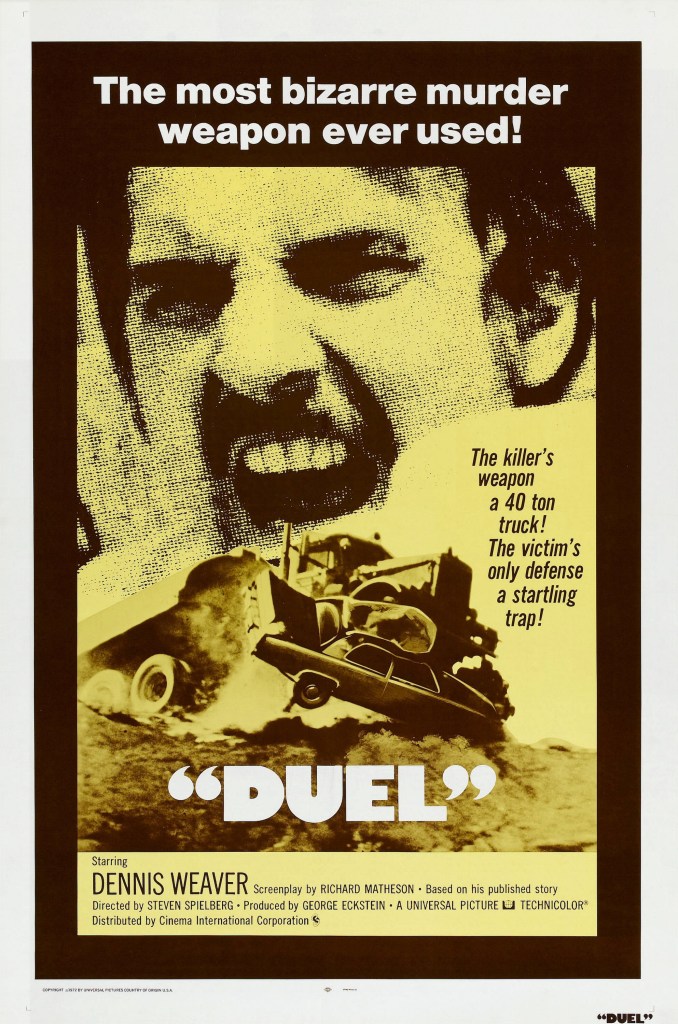
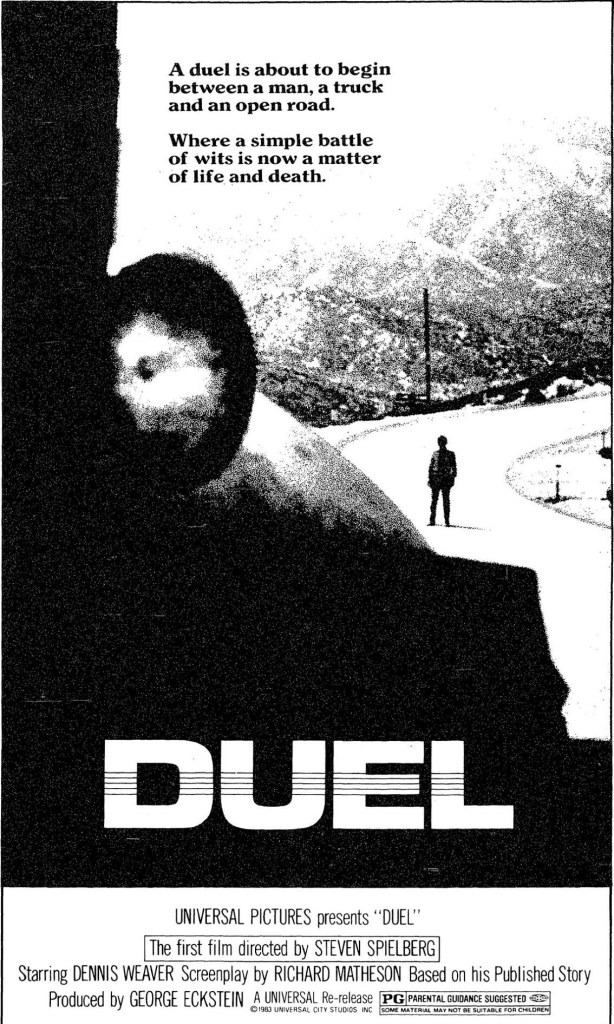
The use of text also re-emphasised the primacy of the truck in the layout. The right-justified text was a matter of necessity – that’s where the spare real estate was – but also, as you read down the bright yellow text , your eye is led right to the truck, with nothing else to attract the eye directly below until you get to the network logo in the bottom right.
All-in-all, a fun, mostly instinctive path through the making of this poster. There’s plenty I would have fixed if I had spent more time, but I think in retrospect the only thing I would have definitely done differently is to lay down the ink work direct onto Bristol board in pen, then scanned. I have better control physically, and once scanned, can always make changes digitally where necessary.
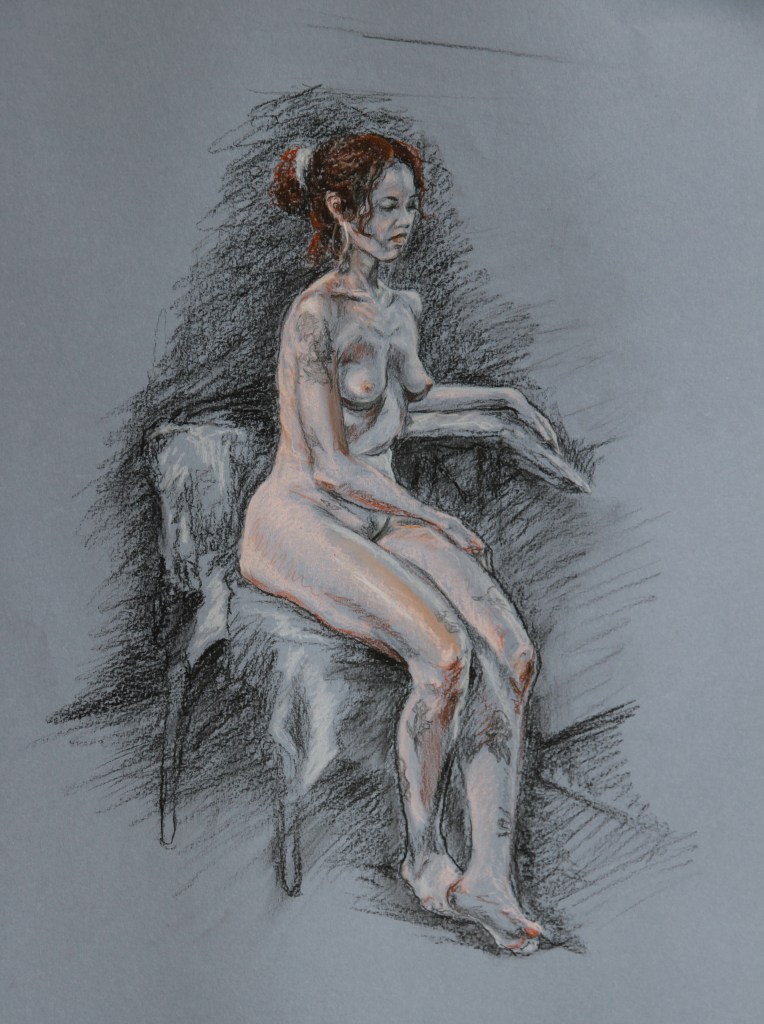
Drawn from life at Candid Arts Trust during one of their long pose Saturday sessions. An amazing and rare chance to really settle in and work through a single piece. I approached without a plan, just a selection of various pencils in the knowledge that I was in no rush.
I started by mapping out the whole figure in vine charcoal, knowing I could swipe it off the smooth side of the Canson paper I was using – gunmetal grey, with the intention of using that cooler midtone to play with the shadows.
I then experimented with using sanguine pencil to map out the structure, but wasn’t keen on how it sat on the background colour. So I reverted to charcoal pencils for the structure, then grabbed two different light pastels for the highlights. I used a fleshtone pink for the hot highlights where the key light sat – nearest to me – and a pale grey with a very light blue tint to it for the reflected light on the off side.
I gradually reintroduced the sanguine pencils to try and bring some life into the picture, to ensure it didn’t read as too cold and harsh. The room itself was far warmer in tone, but I’d committed to the paper choice, so I interpreted the whole scene to fit this gloomier/more dramatic look.
A deceptively tricky pose to capture – really impressive from Paula to hold that tilt in the hips so steadily for hours!

Drawn from a pose reference video from Gesture Drawing Online of the exceptional London-based model Tatiana.

I would like to claim that I was the only kid in Darlington that had a Wu Wear jersey in 1999. It’s probably not true, but I never saw another. I developed an intense fascination with the Wu-Tang Clan in my later secondary school years. Must have been the undeniable parallels I felt, in my formative years on the Grange Estate in Hurworth-on-Tees, with the Park Hill project in Staten Island that birthed the legendary group. To this day, my brother and I can recite the infamous skit from their debut album that precedes the absolutely phenomenal M.E.T.H.O.D. Man (“I’ll just keep feedin’ you, and FEEDIN’ you…”) word-for-word. And often do.
So imagine how nuts I went when I was contacted about the possibility of pitching a cover concept to RZA’s 36 Chambers Record Label for a new album being prepped by long-time group DJ Mathematics. The record was to be themed around Blaxploitation movie scores and tracks, forming the bedrock of each song. I was sent a huge cachet of posters from the era as inspiration, as well as concept art by Mathematics himself – fucking daunting given that he is the man who created the famous W logo. I’d been contacted after posting my Coffy alternative poster. The designs leaned heavily into a busy image of besuited badasses and babes, the draft I saw modelled mostly on 1973’s Black Caesar. Given that this had already been covered, I thought, why not swing for something a bit eye-catching in the same vein? So I cobbled together a direct riff on the brilliant Super Fly poster, a little on the nose of course, but I had a really clear idea of how a white, pink, and purple colour scheme could absolutely jump off the shelves (actual, and digital) in a genre that perhaps shied away from this particular look.
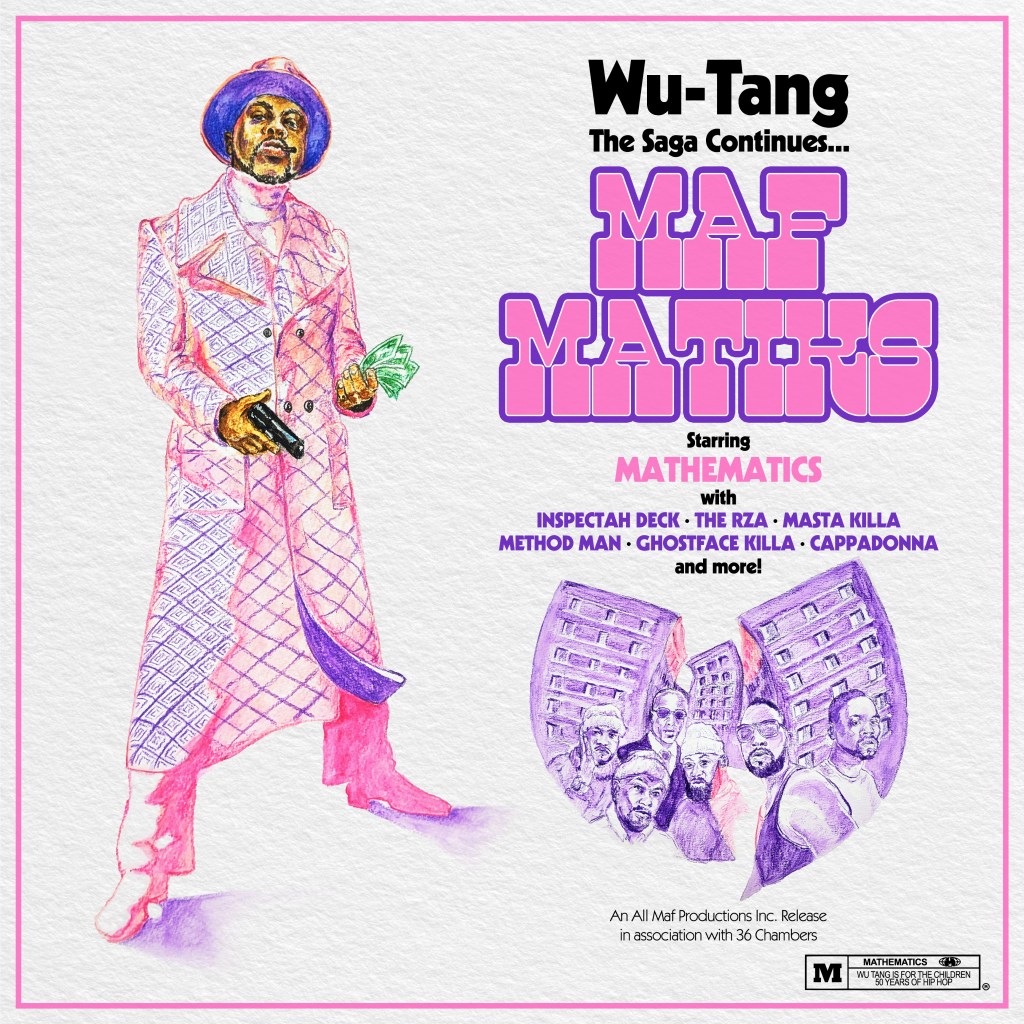
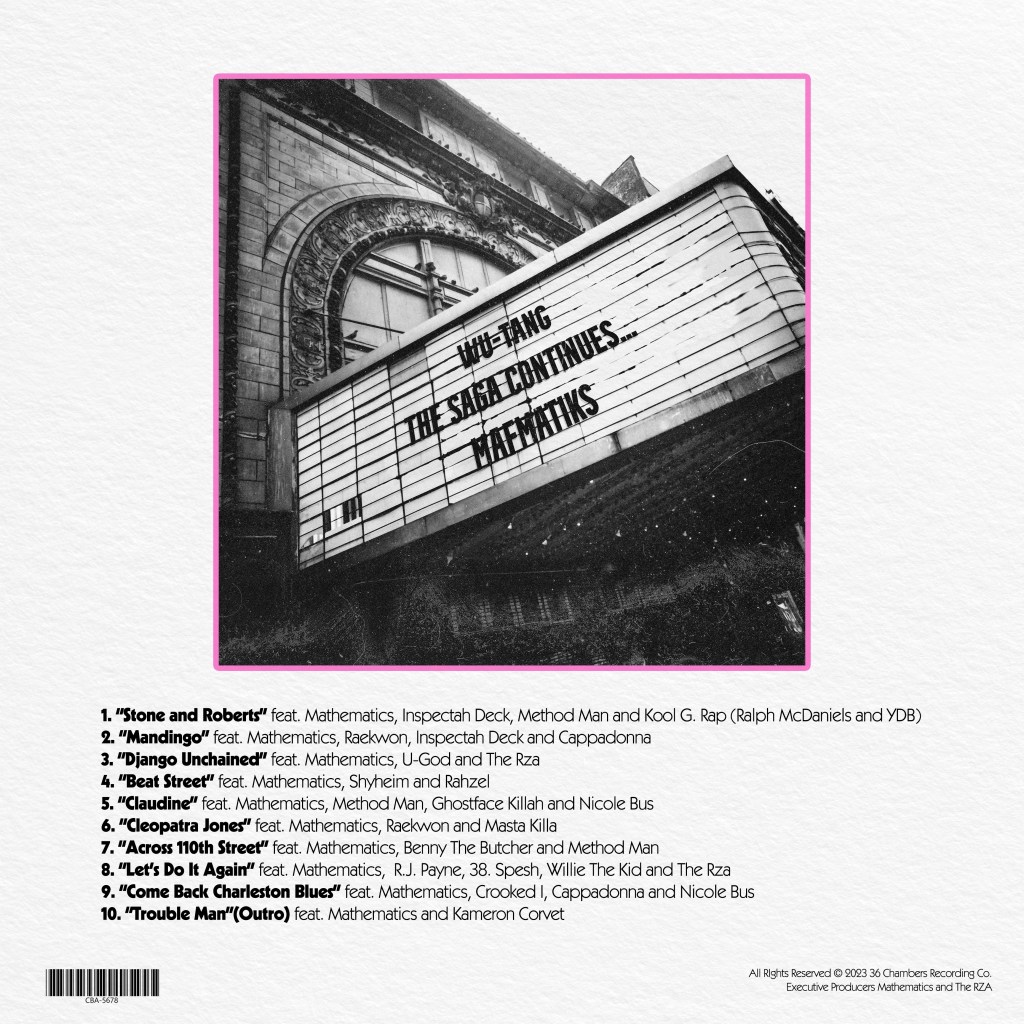
I rushed this placeholder draft out in watercolour pencils, adding a Wu-Tang logo that was hewn out of two tower blocks from that same Park Hill neighbourhood that so fascinated me when I learned how they dubbed the area Shaolin, with the members of the group posed in front of it. On the back cover, I wanted to evoke the nostalgia so many aficionados of cult films feel for the faded fleapits and grindhouses of New York’s 42nd Street. While, for me, this was something I didn’t even know I’d missed until it was long, long gone, the members of the group would have really experienced those cinemas, discovering the Kung Fu gems that so influenced their lexicon.
But, my preferred design sought to reference the brief more tangentially – I saw many posters that used a stark black, yellow, and white colour scheme:

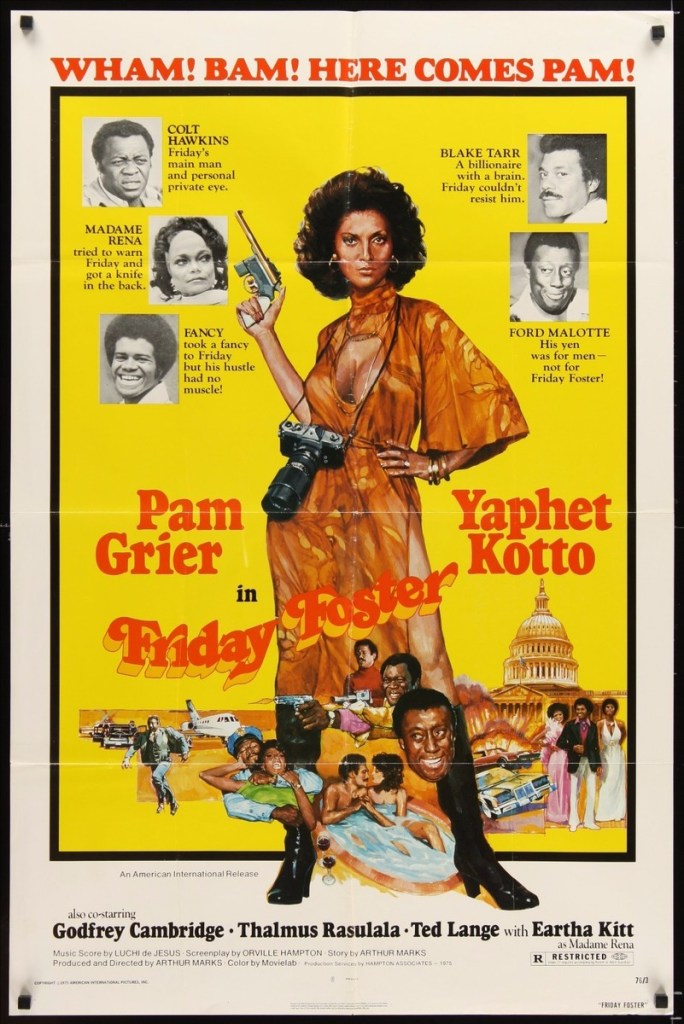
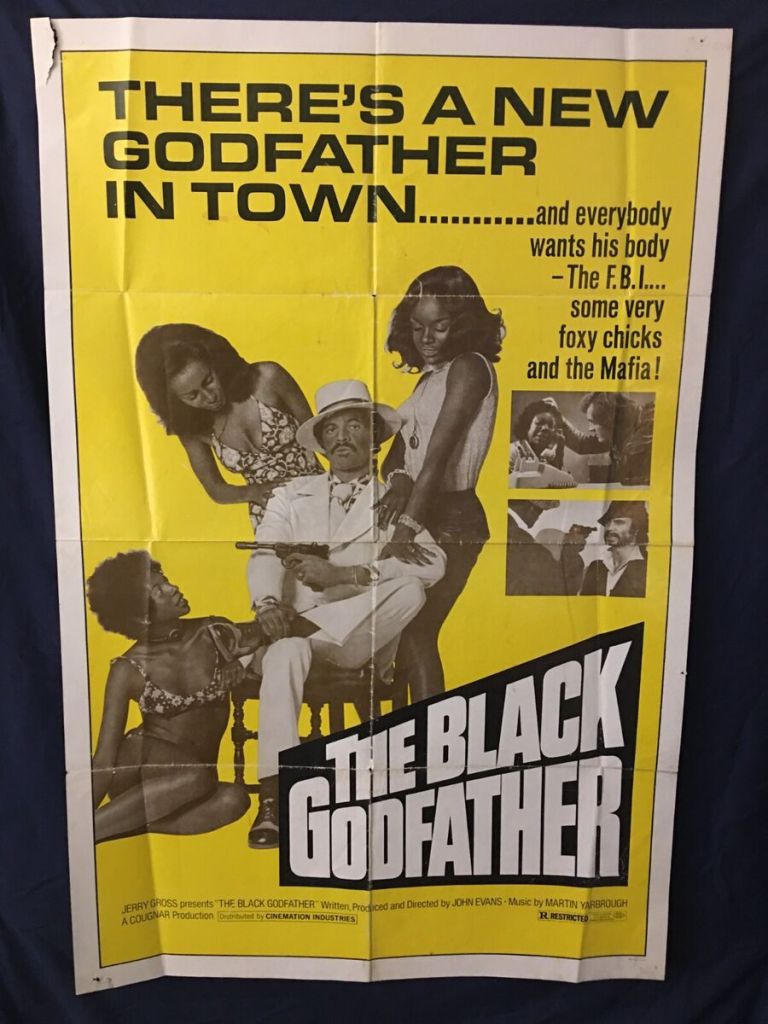
…and figured, what if I could avoid the cliche and the visual overload, while keeping the feel? Many posters include a cityscape, so I grabbed a vintage 1970s photograph of the New York skyline taken from the perspective of the Staten Island ferry as it approaches – figuring, it could evoke the journey the group’s members may have taken into Times Square to see these same, infamous features. I ran a risoprint filter of the image, after isolating the buildings and adding a more highly-contrasted photograph of clouds, to allow for some additional texture.
I ran the filter over the skyline separately, then manually lined up the two images, so that the black and white buildings stood stark against the yellow and white sky.


I used the Wu-Tang W to create a cutout against the buildings, and separately against the sky, and then finally utilised the detailed buildings and bridges to cut off the solid yellow background at the horizon line, leaving the lower third free for ‘credits’ in a font that I felt straddled the line between 1970s-appropriate, with a modern edge. You can see the struts of the bridge at the outer edges if you look close enough.
For the back cover, I repurposed the same image of a broken-down awning, the album name emblazened on it. The work here is extremely rough as it was only intended to be a very indicative, low-res concept pitch, but I thought the overall piece looked like something that brought the right feeling of the 1970s, without seeming too try-hard or tacky. Bold, but not fussy.
Ultimately, of course, this was as far as the job went – I was super happy for the opportunity, a bit bummed out that I didn’t get to contribute to one of my favourite musicians of all time, and fired up to try again.
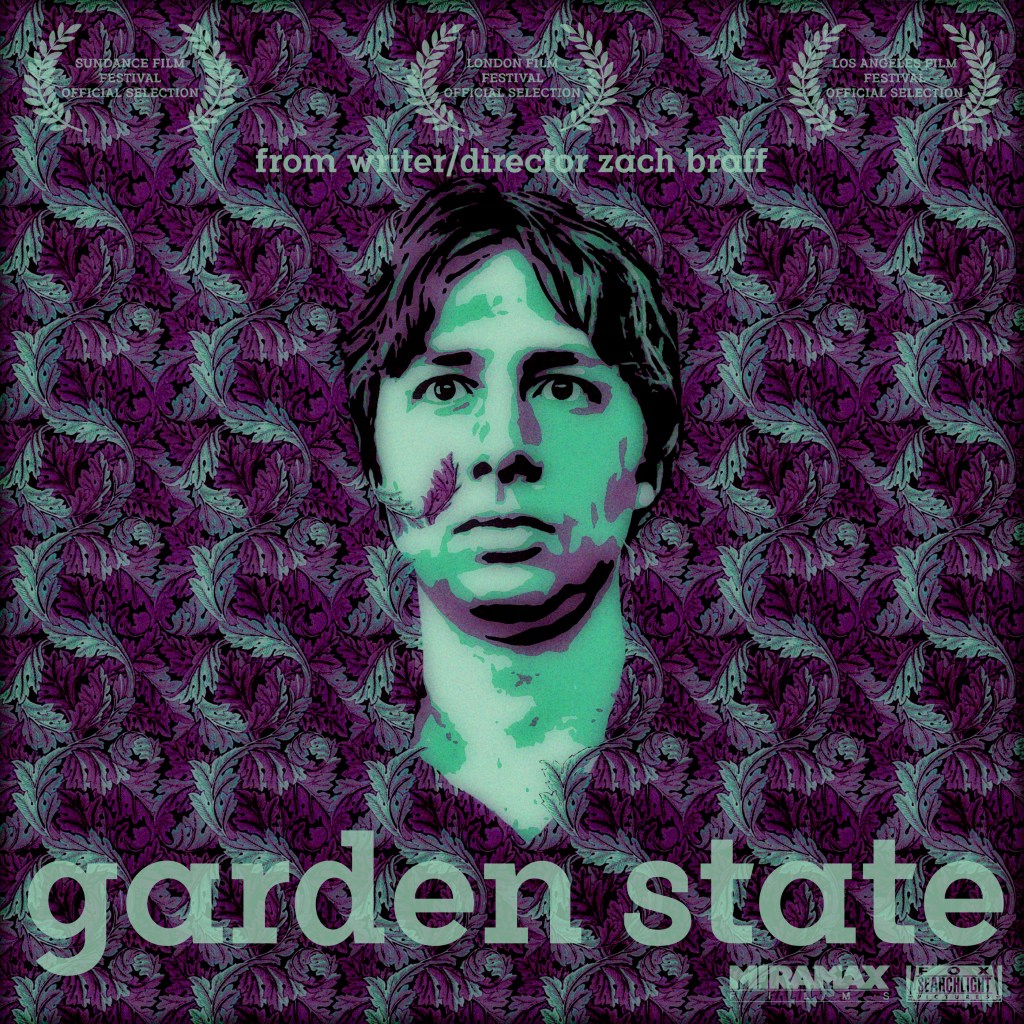
A film I have a complicated relationship with, but made for a really interesting Rewind Movie Podcast episode. I wanted to utilise the very overused, well-known image of Andrew “Large” Largeman sinking into the background as he tries on a shirt made from the same material as the recently renovated bathroom in his childhood home from which he has become so alienated (why was there leftover fabric from a bathroom wall that could be used to make a man’s shirt? I do not know!), but give it a bit more thematic weight.
I sourced the closest analogue I could find of the wallpaper pattern, a William Morris (proud son of Walthamstow!) design called Acanthus. I could only find a small square, so I had to line it up by eye and create a repeatable pattern big enough to fill a Photoshop square. I then eyeballed a purple and green colour-scheme based partly on the screenshots I could source from the movie, and partly one that I thought seemed attractive – aware that I was going to potentially tweak this heavily later.
I used a faux-vectoring technique (I no longer have Illustrator, so have to create a workaround using a YouTube video from TextureLabs that is intended to mimic screenprinting) to create a three colour Braff face, that I matched to the colours in the wallpaper pattern. I manually erased some of his face to allow tendrils of the background plants to show through on his face.
Then, I didn’t like the cartoony boldness – so I ran it through a Studio 2am effect called Indie Dreams, which seemed appropriate in capturing a hazy, early-’00s sensitive colour pallete. There were a number of options, so I used one that shifted more towards a colder green/purple tone. It helped to remove some of the lazy pixellation I’d left in my haste to construct the wallpaper pattern. Finally, I grabbed a font that seemed to match a less familiar release poster I’d found, a blocky serif font called Flamente Cairo. I stuck to the late-Gen-X penchant for all lower case text, and added the same festival laurels that the poster I sourced proclaimed. It felt, again, true to 2004 to trumpet the cachet that came with festival slots in the dog days of the Peak Sundance era.
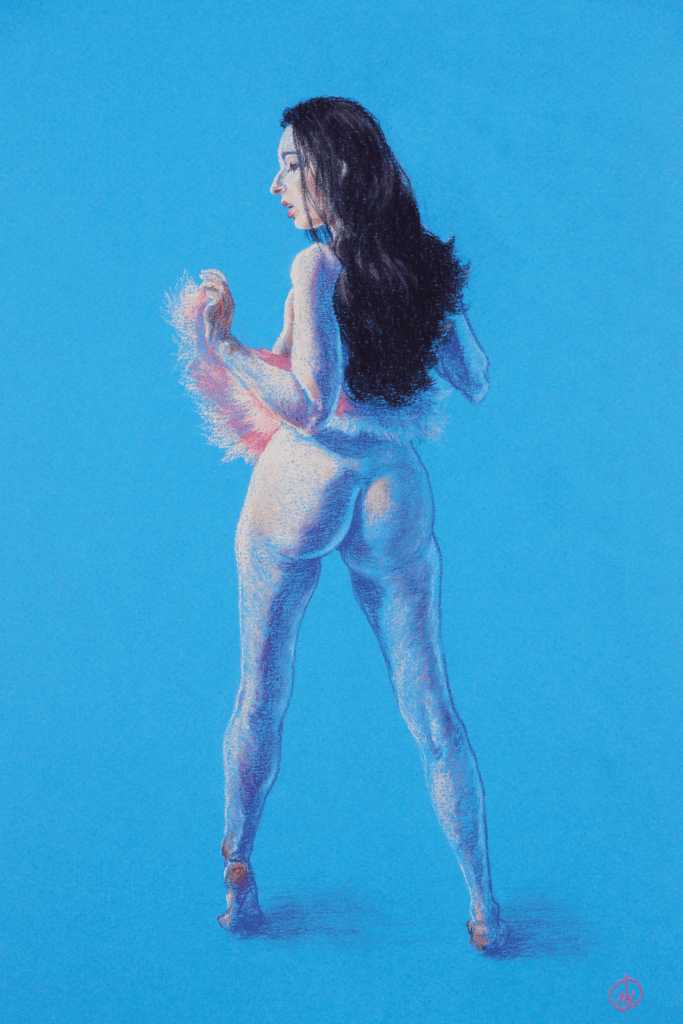
The reference image I found for this sketch had a fantastic interplay of bright, pale key light, and a vibrant blue fill light against a blue background. I wanted to use the density of the pastel across the upper left, through the face and shoulder, to illustrate the more intense light, and let the background show through more sporadic, messy, reflected light in the lower part. On the shadow/key side, a darker blue pencil was used, with a purple pencil to handle the warmer, subsurface scattering as the colder colours meet the pale pinks of the direct light. The flash of pink of the outfit made for a bold focal point to ensure the drawing didn’t end up too cold overall, to establish the hints of pink and pale reds in the skin tones.
Available.
 Dead Penpal